
Warehouse Solutions
The Hidden Cost of a Bad Warehouse Label Install

Jul
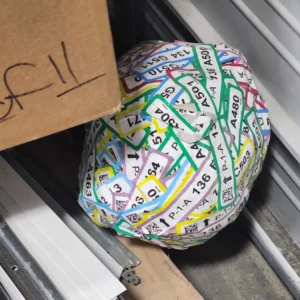
A customer sent us these photos recently. What you’re looking at is a wad of rack location labels, some still stuck together with tape and adhesive, sitting on a warehouse floor next to a roll-up door. Pick-direction arrows, aisle codes, 2D barcodes, color-coded borders for zone identification, all of it peeled off, balled up, and thrown in a pile.
This wasn’t scrap from a test run. This was a full teardown. A different install crew (not ours) had already gone through and applied these labels to the racking, gotten it wrong, and had to strip every single one off and start over.

Why this happens
Applying a label to a beam sounds simple. Sequencing hundreds or thousands of them correctly across an entire warehouse is not. A rack labeling install has to account for the right barcode on the right bay, the pick-direction arrow pointing the correct way, consistent placement height so scanners and pickers can find labels without hunting, and a sequence that matches the warehouse’s actual WMS location scheme rather than just “the next one in the roll.”
Crews that install labels as a side job, or that never worked from a pre-mapped, WMS-matched layout in the first place, tend to catch these problems only after they’re already on the rack. At that point the fix isn’t a touch-up. It’s peeling everything off and reapplying it, which is exactly what these photos show.
What it actually costs
A bad install doesn’t just cost the price of a second set of labels, though that adds up fast when you’re reprinting thousands of them. It costs a second round of labor and lift rental. It costs downtime in a facility that’s supposed to be running, not shut down for a redo. And if a few bad labels don’t get caught before go-live, you’re looking at mis-picks and scanning errors that keep costing you long after the install crew has left.
How we avoid getting to this point
The reason we push customers toward having one team handle design, manufacturing, and installation together is that most install failures start upstream of the install itself. Before our crew ever shows up with a lift, we’ve already pulled in your WMS location data and pre-mapped and sequenced every label to match your actual layout, so the crew installing bay 140 knows exactly what goes there and in what order.
Our crews are certified and trained specifically for this work, not general labor brought in for the week. We run a structured project path with a kickoff, a pre-install check, and cadence meetings throughout the job so problems get caught during a walkthrough, not after the fact. We work around live operations, staging by zone and scheduling during low-impact windows so a warehouse that needs to keep running can keep running. And if something’s missing or doesn’t match once we’re on site, we account for it as part of the process instead of leaving it for someone else to sort out later.
None of that is complicated. It’s just what happens when the same company that designed and printed the labels is the one putting them on the rack, instead of handing that last, most important step to whoever’s cheapest or most available.
The takeaway
That ball of labels is a pretty good picture of what happens when installation gets treated as an afterthought. The labels themselves weren’t the problem. The process around applying them was. If you’re planning a warehouse labeling project, the install crew matters as much as the labels do, and it’s worth checking who’s actually doing that part before the racking gets touched.
Click here to learn more about our warehouse products and services.
