
Warehouse Solutions
Top 5 Mistakes You’ll Make When Labeling Your Warehouse for a WMS Go-Live
Jan
A WMS go-live is one of the most stressful moments in a warehouse’s life.
Timelines are tight.
Teams are stretched.
Everything feels “locked” — even though nothing really is.
And right in the middle of that chaos sits one of the most underestimated components of a successful go-live:
Your warehouse labeling system.
Get it right, and your WMS accelerates productivity from day one.
Get it wrong, and you hard-code confusion into your operation.
After supporting hundreds of warehouse labeling projects tied to WMS implementations, we’ve seen the same mistakes over and over again.
Here are the top five — and how to avoid them.
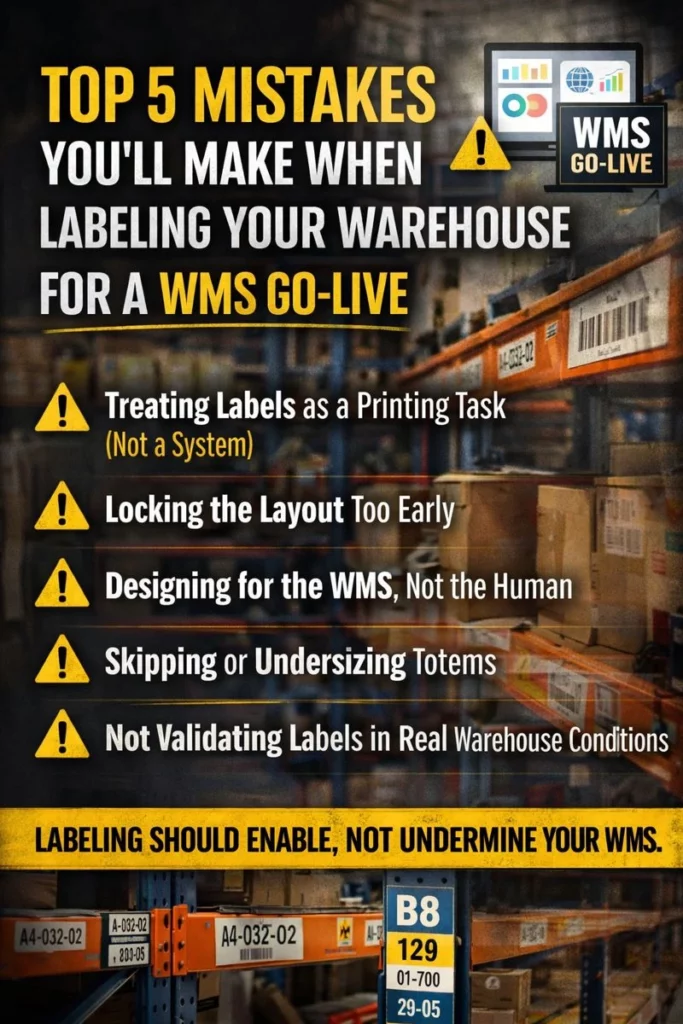
Mistake #1: Treating Labels as a Printing Task Instead of a System Design
This is the most common failure point.
Many teams think labeling starts when artwork is approved and printers turn on.
In reality, that’s the last step.
A warehouse labeling system must be designed around:
- Location logic
- WMS data structure
- Travel paths
- Human readability
- Scan behavior
When labels are created in isolation, you end up with:
- Locations that technically exist in the WMS but don’t make sense on the floor
- Confusing numbering sequences
- Operators stopping to “interpret” labels
Fix it:
Design labeling as a visual system, not a SKU list. Totems, rack labels, floor labels, and signs must work together as one language.
Mistake #2: Locking the Layout Too Early
Here’s an uncomfortable truth:
Your warehouse layout will change — often right after go-live.
Yet many teams finalize permanent labels before:
- Slotting is stabilized
- Velocity is proven
- Pick paths are validated
- Volume patterns are known
That leads to expensive reprints, rushed fixes, and manual workarounds.
Fix it:
Use magnetic labels and magnetic totems in areas likely to change. This gives you flexibility during stabilization without sacrificing clarity or scan accuracy.
Mistake #3: Designing for the WMS — Not the Human
Yes, your WMS needs precise location IDs.
But your people need instant visual clarity.
Too many warehouses label strictly to satisfy software logic:
- Long alphanumeric strings
- No visual hierarchy
- Small fonts
- Zero color logic
The result?
People slow down. Errors increase. Confidence drops.
Fix it:
Design labels for humans first, scanners second.
Use:
- Clear aisle identifiers (totems)
- Logical vertical ranges
- Color-coded zones where appropriate
- Fonts readable from real working distances
When humans move confidently, scan accuracy improves automatically.
Mistake #4: Skipping Totem Labels (or Undersizing Them)
Totem labels are the anchor of a WMS-enabled warehouse.
They tell operators where they are before they ever scan a location.
Yet we still see:
- Totems that are too small to read
- Totems blocked by pallets
- No vertical range context
- Inconsistent placement
Without strong totems, operators rely on trial-and-error scanning — exactly what a WMS is supposed to eliminate.
Fix it:
Install high-visibility totem labels at every aisle or row end. Totems should:
- Be readable from a distance
- Clearly define vertical location ranges
- Match the numbering logic in the WMS
- Act as the “street signs” of your warehouse
Mistake #5: Not Validating Labels in the Real Environment
Labels that look perfect on a proof can fail instantly on the floor.
Common issues include:
- Glare from lighting
- Poor contrast
- Adhesives failing in cold or dusty environments
- Barcodes placed where forks or stretch wrap damage them
Skipping real-world validation is a gamble — and go-live is the worst time to gamble.
Fix it:
Validate labels in the actual warehouse conditions:
- Lighting
- Temperature
- Traffic patterns
- Forklift interaction zones
This is why experienced warehouse labeling partners insist on site walks, mock-ups, and final inspections.
Why Labeling Mistakes Hurt More During WMS Go-Live
During go-live:
- Teams are learning new workflows
- Error tolerance is low
- Confidence matters
- Supervisors are already overloaded
Labeling confusion doesn’t just slow work — it undermines trust in the system.
And once workarounds start, they tend to stick.
How Pacific Barcode Approaches WMS-Driven Labeling
At Pacific Barcode Inc., we treat warehouse labeling as part of the WMS enablement process, not a side task.
Our Warehouse Division focuses on:
- System-level label design
- Totem-driven wayfinding
- Magnetic + permanent hybrid strategies
- ISO-driven installation execution
- Validation before, during, and after go-live
The goal isn’t just clean labels.
The goal is day-one confidence.
Final Thought
A WMS doesn’t fix a warehouse by itself.
It relies on:
- Clear locations
- Logical movement
- Visual confidence
- Consistent execution
Your labeling system is what connects the digital world to the physical one.
Get it wrong, and the WMS struggles.
Get it right, and everything else gets easier.
